Saturday, April 6, 2013
New to the life list!
Added six new birds to our life list today! Tundra Swans, Blue-winged Teal, Green Teal, Horned Grebe, Red-necked Grebe, and Red-breasted Merganser. Just wanted to share our excitement :) (first three seen in very wet fields just outside Milton, ON and the other three seen in Col. Sam Smith Park in Etobicoke)


Monday, January 14, 2013
Happy New Year!
I am well overdue to post. Since our last update, we have moved (still miss our old place and our birds...), settled in to a new house, traveled to Arizona (where we added many new species to our life lists- Vermillion Flycatchers are so beautiful!), spent the holidays in a flu-induced daze and how here we are.
I saw this article and it reminded me of the issues our Bobolinks are facing. Thought I would share it to show that compromise with farmers/land owners is possible.
Farmers Delay Harvesting for Birds
California dairy farmers help protect thousands of tricolored blackbirds.
By Julie Leibach
Published: January-February 2013
California’s fertile Central Valley attracts more than 90 percent of the world’s tricolored blackbirds, an Audubon priority species that forms the largest songbird colonies in the nation. The birds prefer nesting in dense marsh foliage, where they live communally by the tens of thousands. But as farming has boomed over the past century and wetlands have been drained, the population has declined to about 260,000. Tricolors have increasingly moved into maturing wheat fields on dairy farms (the grain is fed to cows). Biologists from the Natural Resources Conservation Service’s Tricolored Blackbird Habitat Initiative, along with Keiller Kyle, Audubon California’s bird conservation project manager and adviser to the project, are encouraging dairy farmers to delay harvesting until the birds have successfully fledged; participants are compensated for any crop losses. Last year four dairy farmers joined, helping to protect 60,000 breeding birds.
This story originally ran in the January-February 2013 issue as "Delayed Gratification."
Saturday, August 4, 2012
What is happening to Florida’s grasshopper sparrow?
Published on Saturday August 04, 2012
Kevin Spear
The Orlando Sentinel
KENANSVILLE, FLA.—A type of sparrow that lives only in Florida has mysteriously plunged in number so dramatically that scientists fear it will vanish well before the end of this decade.
Florida grasshopper sparrows, which inhabit grasslands in the state’s interior south of Orlando, have been listed as endangered for 26 years. But the furtive birds have all but disappeared in recent years from one of their last three prairie refuges and, in what has become a wildlife emergency, may now total fewer than 200 in just two counties.
The sparrows’ extinction would likely be the nation’s first loss of a bird since the late 1980s, according to the Cornell Lab of Ornithology. That’s when the dusky seaside sparrow, also a Florida native, slipped out of existence. The threat of losing another bird unique to Florida alarms scientists.
“This seems to be the most highly imperiled bird in all of mainland North America,” said Reed Noss, a biology professor at the University of Central Florida. “At the present rate of decline, it’s going to be extinct in as few as three years and, unbelievably, we don’t know why.”
The small bird is firmly adapted to “dry prairie.” Florida had more than 1.2 million acres of that treeless terrain, but 90 per cent was turned into inhospitable cattle pasture by the end of the 20th century. The bit that remains is one the state’s last old-growth landscapes, an ecosystem carpeted with an astounding variety of grasses and flowering plants.
Scientists have no doubt that the loss of habitat caused most of the bird’s decline. As for what’s behind the recent population dive, they surmise invading fire ants are eating chicks and increasingly variable weather is flooding more nests. They also suspect disease and loss of genetic diversity. The various factors could also be acting together in what scientists call an “extinction vortex.”
The bird eats grasshoppers and sings like one, with a “tick, tick, buzz.” It also tends to run — hidden by dry-prairie grasses — bedevilling researchers’ attempts to study it.
What might be the bird’s most serious threat now, researchers fear, is indifference to its plight. Florida grasshopper sparrows do not visit backyard feeders, nor do they elicit the popular affection shown for the likes of West Indian manatees and Florida panthers.
But officials at the U.S. Fish and Wildlife Service, saying they are treating it as an emergency, have raided their tight budget to fund accelerated studies, push for restoration of dry prairie, and took the unusual step of assigning a biologist to focus full time on the bird.
Monday, July 30, 2012
More Bluebirds
We have a second brood of baby Bluebirds in the nesting box (say that three times fast!) Neither the Tree or Barn Swallows did a second a round this year. I was really hoping the Barn Swallows would after the disaster, but they did not. There are four baby Bluebirds in the nesting box. Mom and Dad and the siblings from the first brood are all hanging around still. It's been great to have them and I was so pleased when Dave checked the box last week after noticing activity. I've noticed the House Wren has been very active lately and I'd like to get a look in their box to see if they are doing a second round. I wonder if the dry conditions are having an impact on the birds and their choices to do another round or not? We usually have two broods from the Tree Swallows.
I'd also like to add that I have not seen a House Finch out here in months and months. I wonder if the eye disease wiped out the local population (that in the immediate vicinity). We definitely saw many birds suffering from it and it was awful. I see House Finches when I'm visiting my parents, but have not seen any here in probably a year.
Also of note, almost all the fields where Bobolinks would nest were mowed by mid to late June and definitely all done by Canada Day weekend. Odds of any nesting success must have been slim to none in those areas. We did go out June 23rd and we heard many Bobolinks calling, but a week later the habitat was destroyed. I think, again, due to the dry summer, this lead to the hay being cut even earlier than usual.
And in case I didn't mention it, we had s successful Baltimore Oriole nesting somewhere nearby. We had a male with two juveniles visiting the grape jelly feeder on a regular basis.
Grosbeak numbers seemed to be down this year. We occasionally saw one female and two or three males, but that was it. There was one or two males who visited the grape jelly on a regular basis and that was it.
Great story!
Nesting barn swallows delay renovations at Mississauga’s Riverwood Conservancy
Published on Monday July 30, 2012
Emily Jackson Staff Reporter
Renovations to the carport of a Mississauga heritage house will have to wait until a group of stubborn barn swallows vacates the premises.
The swallows, which prefer to nest in old structures such as barns and bridges, have spent their summers at The Riverwood Conservancy’s 93-year-old Chappell House carport for as long as volunteers can remember.
So when the wooden roof was blocked off to protect the birds during construction — the city deemed the roof structurally unsound and planned to rebuild — the birds simply broke through the barrier, made nests and laid eggs.
Longtime Riverwood volunteers alerted the city to the birds’ somewhat precarious situation.
To the delight of conservationists, and perhaps the barn swallows themselves, the city removed the barrier and delayed repairs until the birds fly south to Central and South America for the winter.
The city followed the guidelines of the Endangered Species Act, said project manager Laila Gabiazon, and will preserve the birds’ habitat when construction continues this fall.
The birds’ clout in municipal decisions stems from the federal government’s designation of the species as “threatened” in May 2011. While there are about 4.9 million adult barn swallows in Canada, the population has declined about 30 per cent over the past 10 years.
This is troubling because the birds eat insects, including flies and aphids, according to a Committee on the Status of Endangered Wildlife in Canada report.
“The magnitude and geographic extent of the decline are cause for conservation concern,” the report states.
Exact reasons for the decline aren’t known, but it is partly because of the destruction of old structures where barn swallows prefer to mate, such as open barns. A switch to modern agricultural methods could be another contributor to the decline.
Riverwood is extremely pleased the city stopped construction, said Dave Taylor, education program director at the public garden and nature preserve in the Burnhamthorpe Rd. W.-Creditview Rd. area.
“The laws make it pretty clear on what you can and can’t do,” he said. “Barn swallows are more numerous now, but because barns are being torn down all over the province they’re losing numbers and declining.”
But these fortunate barn swallows got to keep their summer home. Their first brood has already fledged, Taylor said, and they’re starting on their second round of breeding.
Sunday, July 8, 2012
Wednesday, June 27, 2012
Today's Star has an article on a recent study on the state of birds in Canada
Last night we came home to see that our Barn Swallow nest had been destroyed and there was evidence of feathers around the broken nest. We checked on the five babies only a few days ago and they were very close to being ready to fledge. I am heart broken to report that the evidence leads us to conclude the babies did not survive the attack. I am guessing a raccoon somehow managed to get to the nest, but I am not sure how it would have managed to do so. The Barn Swallows have used this spot in the past and it has been safe from predators. The adult pair was still around and giving their warning calls. I can't imagine how awful it was for them to witness the attack and be relatively helpless in defending their young. This is very discouraging.
On a positive note, our Tree Swallows and Bluebirds have fledged successfully. Hopefully both sets of parents will give it another go. The House Wrens are still busy going in and out of the box.
As for our Bobolinks, the farmers have been cutting their fields very early (so it seems to me). Most of the potential nesting grounds have already been cut. We went out on Sunday and saw/heard many out in the fields. Last night we did a check and at least three of the fields have been cut. I highly doubt there was time for any eggs to hatch.
Overall, I'm feeling quite a bit down this morning. It feels like the birds are fighting a losing battle. I have to remind myself of the nesting success stories and be hopeful that the areas that are currently protected will remain so.
Sunday, June 17, 2012
Hatchings!
Looks like all the eggs hatched successfully!
Five Bluebird chicks
 Seven House Wrens
 Five Tree Swallows
 Five Barn Swallows
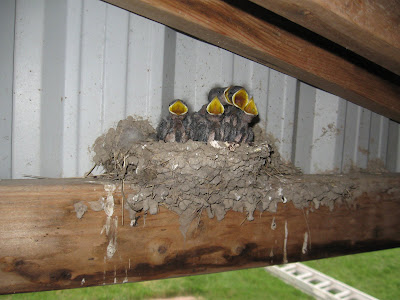 Yay!
Yay!
 Seven House Wrens
 Five Tree Swallows
 Five Barn Swallows
 Yay!
Yay!
Sunday, June 3, 2012
Updates
We participated in the Chimney Swift count last night. Our site was St Paul's church in Milton. We had a good time (despite the pouring rain!) and we are happy to report that both chimneys are used by the swifts for roosting. I'm looking forward to seeing the results for all the Halton sites.
 Dave took pictures of our nesting boxes today. Seven eggs in the House Wren box, Unknown for the Tree Swallows because mamma or daddy was not budging! Five each for the Barn Swallows and the Eastern Bluebirds. Fantastic results!
House Wren Nest
Dave took pictures of our nesting boxes today. Seven eggs in the House Wren box, Unknown for the Tree Swallows because mamma or daddy was not budging! Five each for the Barn Swallows and the Eastern Bluebirds. Fantastic results!
House Wren Nest
 Barn Swallow Nest
 Simon helping with the nesting box check:

 Tree Swallow telling us it's none of our business what's going on in there:
 Bluebird nesting box:
 We are also seeing adult birds come to the feeders and take heaping amounts of food and fly off with it, so we know there are others nesting in the trees etc- Grackles, Blue Jays, Cardinals, Baltimore Oriole (haven't seen the female in a few days, so assume she is busy on the nest), Red-bellied Woodpecker (again, the male is visiting quite a bit- especially the grape jelly feeder!), Rose-breasted Grosbeak (seeing the male only. And as an aside, we have not had the larger numbers of male and female Grosbeaks we normally do. We had a few males for a few days- up to three, I think and maybe two females. After that, it's just been the single pair. Would be curious to know if their numbers are down this year?).
 As for Bobolinks, I have seen two males. That's it. Maybe it's still early? But the fields we normally see them in have had some of their fencing removed, so the males don't have the same number of posts to perch on. I'll spend more time out there this week to see what's going on.
The Northern Flicker has been very noisy lately, but this was the first sighting I'd had of him in awhile:
As for Bobolinks, I have seen two males. That's it. Maybe it's still early? But the fields we normally see them in have had some of their fencing removed, so the males don't have the same number of posts to perch on. I'll spend more time out there this week to see what's going on.
The Northern Flicker has been very noisy lately, but this was the first sighting I'd had of him in awhile:
 Also, we've had a Red Squirrel out here the last week or so. We have never seen one here before. I need to find out if that's a unique sighting. I have no idea if they are really in the area or not.


Sunday, May 20, 2012
Cliff Swallows!
If you have not had the opportunity to see a Cliff Swallow, then you must get to Mountsberg (a Conservation Halton park). There is a plethora of Cliff Swallows nesting along the barns. It's amazing how many there are and all so close together! Definitely worth the trip (plus Mountsberg is just a really amazing spot in general. A great family outing!).


 In other news, a pair of Bluebirds has returned to the yard (no idea if it's the same pair from a month or so ago) and are using the nesting box. Here's hoping we have some Bluebird babies again this year!
 and just as I hit "publish" I had to go back in to add that there's a Blackpoll Warbler in the yard! First sighting this year. Nice way to end a beautiful day!


Wednesday, May 16, 2012
Volunteers Needed to Help Monitor Chimney Swifts
From Conservation Halton:
Volunteers Needed to Help Monitor Chimney Swifts
We are looking for community volunteers interested in helping the national effort to monitor Chimney Swifts right here in Halton.
This at risk bird is in decline and we are seeking volunteers who can visit by visiting known roost sites on three evenings this spring (May 29, June 2 and June 6). Data will help national recovery efforts as part of the Bird Studies Canada program by monitoring populations and identifying active chimneys. For more information on how you can get involved please e-mail Nigel Finney at nfinney(at)hrca.on.ca.
Please respond by May 25 and include which dates you are available and your preferred community to monitor (Burlington, Oakville, Milton).
Grosbeaks and Orioles.
The male Rose-breasted Grosbeak has been visiting the jelly feeder we have out for the Orioles. I've seen him take beak fulls and feed a female RBG. We've never seen this before, but I wonder if it's because we haven't had as much suet out this year?
The Orioles are also enjoying the jelly (as are the chipmunks). There are at least two males and one female. One of the males came up to the feeder and had some nesting material in it's beak, which it had to drop in order to scoop up the jelly.
Indigo Buntings are in the area (Dave saw quite a few in Glenorchy) but I haven't caught sight of any in the yard yet. There was a Great-crested Flycatcher in the trees for quite awhile yesterday. Just waiting for the Bobolinks to arrive!


Friday, May 11, 2012
Friday, May 4, 2012
Thursday, May 3, 2012
More exciting arrivals! Yesterday was the first Baltimore Oriole of the season, and so I quickly put out oranges and grape jelly for them. Today I was rewarded with two male Orioles visiting repeatedly. We also saw two male Rose-breasted Grosbeaks for the first time this spring. So exciting to have them back! There was also a Cowbird in the yard, the first in at least several weeks.
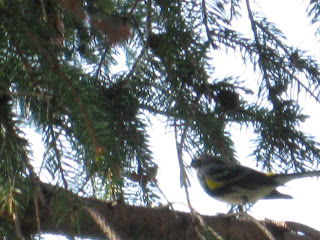
Late afternoon, I drove over to my parents place to pick up my dogs. Simon fell asleep in the car, so I parked under their pine tree and opened the doors and windows. Looking up, I saw several small birds flitting around. Warblers! I was so excited! I called my parents on the phone and told them to look out the window. There were at least two male Yellow-rumped Warblers and one female. They were so close to me! It was the best look I've ever had at any warbler (except the ones we did the banding of at Mountsberg). They were literally a few feet above me. I just sat quietly and they kept moving in and then out. Amazing! Then I noticed one was smaller and looked different and I'm fairly certain it was a Ruby-crowned Kinglet. It was great to be able to see all the markings and not even have binoculars (note to self: do not travel this time of year anywhere without binoculars and Sibley's!!). I'm so glad I grabbed the camera last minute on my way out. I did get some pics, but as usual they are not very good b/c the birds move so fast and my camera is not so great. Such a great way to spend the evening! The birds stayed in the tree for the two hours I was there and even when I went inside, I was able to borrow my parents' binoculars and watch them longer. This also goes to show that if you make a bird friendly yard, they will come!!


Sunday, April 29, 2012
Spring Arrivals 2
We had a House Wren visiting the nesting boxes out back a few days ago. He was checking out the boxes the wrens have used for years. They usually pick one for a nest and fill the other with sticks as a decoy nest.
Tree Swallows are busy checking out all the nesting boxes as well. We have Chipping Sparrows visiting the yard daily.
Last night, we saw the first Barn Swallow of the season and a Northern Rough-winged Swallow (one we don't see too often). Dave was able to ID it by the call.
Saturday, April 14, 2012
New spring arrivals...


We had Kinglets in the trees (but it was so sunny out, we couldn't get a firm ID on whether they were Golden or Ruby-crowned) and one of our very favourites, the Tree Swallow! I caught a glimpse of a swallow yesterday and today we saw quite a few flying around. So glad they are back!
Wednesday, March 21, 2012
Eastern Phoebe


On Sunday, March 18th, we had our first Eastern Phoebe sighting in the backyard! Welcome back!
Saturday, March 17, 2012
Busy Bluebirds


The Bluebirds spent some time checking out nesting boxes. We saw the male and female bringing nesting materials to one of the boxes,but then later they were investigating a different box. Seems very early in the season, but we're always so happy to have them. Usually the first nesting box residents are the Tree Swallows and then the House Wrens.
Subscribe to:
Posts (Atom)

 Posts
Posts


